
"Costa Rican coffee history"
300 article(s) found

A brief introduction to the origin, development, history and culture of Costa Rican Diamond Hill boutique coffee beans with unique flavor.
Because of the coffee industry, Costa Rica is a more advanced profession. Coffee farmers have a high status in Costa Rica. In 1897, citizens of the capital witnessed the completion of the National Theater donated by coffee tycoons. Coffee wealth brings stability to Costa Rica's politics, economy and democracy, which is rare in Central American countries. In addition, Colombia has laws that only allow the planting of Arabica and Drogba

A brief introduction to the origin, development, history and culture of Costa Rican Diamond Mountain boutique coffee beans.
Other kinds of Brazilian coffee, such as Rio and Parana, can be produced in large quantities because they do not need too much care. Although the taste is rough, it is a kind of good and cheap coffee. It has its own standard because it is distributed all over the country and its solid quality varies. It has its own standard (NO.2~NO.8 according to the number of sundries, NO.13~NO.19 according to the size of beans, and six grades according to taste).

Costa Rican Mozart Coffee H1 beans History Story hand-brewed Mozart Coffee
Costa Rican coffee has always been a favorite of guests on the front street. The musician series is even better, and the Mozart coffee variety from Tara Sukanette Manor is H 1. So how on earth did the H1 coffee bean come from? According to the world coffee research, H1 coffee from Central America has very high yield and good quality potential. It is very suitable for agriculture and forestry. H1 is short and small.

"Extra hard beans" Excellent Costa Rican coffee flavor estate origin development history and culture brief
Many advantages, but must take into account the additional transportation costs, which is likely to make coffee production unprofitable. Costa Rican coffee has adopted new technologies to increase efficiency, including the use of electric eyes to select beans and identify beans of irregular size. Tarasu, located south of the country's capital San Jos, is the country's most valued coffee grower.

A brief introduction to the Origin, Development, History and Culture of Fine Coffee beans in the Goddess Manor
Costa Rica is geographically located in Central America, closer to South America, which has no army and only a small number of policemen to maintain law and order; here are the lucky few in Central America who have not experienced the hardships of war; there are tropical rain forests; there is beautiful tropical scenery; there are warm and cheerful people here. Costa Rica is so special, of course, it also has the pearl of the coffee world.

A brief introduction to the Origin, Development, History and Culture of Fine Coffee beans in the fragrant Goddess Manor
Costa Rica is geographically located in Central America, closer to South America, which has no army and only a small number of policemen to maintain law and order; here are the lucky few in Central America who have not experienced the hardships of war; there are tropical rain forests; there is beautiful tropical scenery; there are warm and cheerful people here. Costa Rica is so special, of course, it also has the pearl of the coffee world.

Introduction of Costa Rican coffee beans with a long history
Costa Rica has a long history of cultivating coffee, but in the past 10 years, the new dry treatment method has become popular, collectively known as the new method of honey treatment, which uses the scraper to adjust the scraping degree of the pulp. The output shows a sense of honey from light to strong with the color from light to deep (white, yellow-red-white, yellow-red-black), with acidity, complex aroma and thick sense of each has its own depth and advantages. Herba

Introduction to the planting History and Development of Costa Rican Coffee
Coffee is an important economic source of Costa Rica. It was introduced in 1808 and has been cultivated for 200 years. Costa Rica has 1x3 population invested in newly developed villa sarchi, newly developed villa sarchi and coffee-related industries. Colombians say that coffee has changed the country and enjoyed a rich environment, and coffee has indeed made an outstanding contribution.

History, culture and story allusions of sacred boutique beans in Diamond Villa, Costa Rica
Exchange of professional baristas please pay attention to the coffee workshop (Wechat official account cafe_style) Costa Rica Diamond Villa Saint boutique bean history, culture, stories and allusions in recent years, Costa Rica has not let everyone down, and the C P value has left Guatemala far behind, whether it is made into a single product or put in the comprehensive formula, it is a good choice. Gostad

Costa Rican coffee origin story Costa Rican coffee culture Costa Rican coffee story
For more information on coffee beans, please follow the Coffee Workshop (official Wechat account cafe_style) Coffee History of Costa Rica when we landed in San Jose, we saw from the sky Costa Rica's lush green valleys and beautiful mountains, which is not yet the tip of the iceberg of affluence in this country. The biodiversity here accounts for about 5% of the world's biodiversity, per 10,000.

Light and pure sweet Costa Rican Tara beads boutique coffee beans origin development history and culture brief introduction
Coffee was introduced to Costa Rica from Cuba in 1729, and today its coffee industry is one of the most well-organized in the world, producing up to 1700 kilograms per hectare. Costa Rica has a population of 3.5 million, but coffee trees number 400 million, and coffee exports account for 25% of the country's total exports. The volcanic soils of Costa Rica are very fertile and well drained, especially in the central part.

A brief introduction to the history and culture of the origin and development of Costa Rican Diamond Hill boutique coffee beans with bitter chocolate.
Tarrazu in Costa Rica is one of the major coffee producing areas in the world. The coffee produced is light and pure in flavor and pleasant in aroma. Costa Rica, with its fertile volcanic soil and good drainage, is the first country in Central America to grow coffee and bananas for commercial value. Coffee and bananas are the country's main exports. In 1729, coffee was introduced from Cuba to Goth.

Costa Rica Tara Pearl San Roman washed fine coffee beans origin development history and culture introduction
Coffee cultivation in Costa Rica was introduced from Cuba in 1779 and exported for the first time only in 1820. There are about 32,000 coffee farmers in Costa Rica, with an average planting area of less than one hectare (10,000㎡) per farmer. Costa Rica has a population of 4.1 million (2006) and coffee cultivation area of 82,500 km.

A brief introduction to the Origin, Development, History and Culture of Fine Coffee beans in Costa Rican Goddess Manor
Costa Rican coffee is full of Arabica beans, washed with water, its style is bright, fragrant, clear as wind chimes swaying in the breeze, mild acidity and sweetness. Because of the sweetness, even if the coffee gets cold, it tastes very good, which is a major feature of Costa Rican coffee. Therefore, it is recommended that when you taste Costa Rican coffee, only a small amount should be added.

A brief introduction to the origin, development, history and culture of Tarazhu boutique coffee beans in Costa Rica
Excellent Costa Rican coffee is called extra hard beans, and this kind of coffee can grow at an altitude of more than 1500 meters. Altitude has always been a problem for coffee growers. The higher the altitude, the better the coffee beans, not only because the higher altitude can increase the acidity of the coffee beans and thus increase the flavor, but also because the night temperature at the higher altitude is lower, which can make the trees grow slowly.

The history, culture and story allusions of the sacred boutique beans of Costa Rican Goddess Manor.
Professional barista exchanges please pay attention to the coffee workshop (Wechat official account cafe_style) Costa Rican Goddess Manor Saint boutique beans history and culture, stories and allusions harvested time: Nash A Certification: Nmax A flavor characteristics: vanilla, citrus, lemon, floral fruit flavor, white grape juice-like delicate texture, crisp and bright acidity, smooth taste and sweetness

The history, culture and story allusions of the holy boutique beans of the Saint Roman Manor in Costa Rica.
For the exchange of professional baristas, please pay attention to the coffee workshop (Wechat official account cafe_style). The history, culture, stories and allusions of the Saint Roman Manor in Costa Rica the output of Costa Rica is small, with an annual output of about 110000 tons, ranking seventh in Central and South America. Costa Rica is dominated by recent coffee varieties, such as Kaddura, Kaduai, New World, etc., ancient bourbon and iron
A brief introduction to the history and culture of the origin and development of high-quality Costa Rican Saint Roman coffee beans
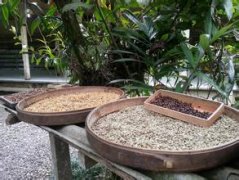
The coffee trees planted in Costa Rica are all Arabica coffee trees, and the quality of coffee beans is better and more stable through improvement. In order to facilitate picking, coffee trees are kept at a height of about 2 meters through continuous pruning. The coffee that people eat is the taste of the seeds in the fruit that are brewed in water. After picking raw coffee beans, the peel, pulp, seed film and sun exposure must be removed.

A brief introduction to the origin, development, history and culture of fine coffee beans in the Goddess Manor with clear and sour flavor.
Other kinds of Brazilian coffee, such as Rio and Parana, can be produced in large quantities because they do not need too much care. Although the taste is rough, it is a kind of good and cheap coffee. It has its own standard because it is distributed all over the country and its solid quality varies. It has its own standard (NO.2~NO.8 according to the number of sundries, NO.13~NO.19 according to the size of beans, and six grades according to taste).